
Novelty (All Kinds)
Where would we be without the bizarre, the truly weird and the comically beautiful?! If you want to “gross” someone out with “fur” or impress them with multi-clusters or amaze them with 5 colored fruits, all on one plant, this would be where you will find the finest in this category. Watch out, some might even have spikes! We have hunted high and low for many of these. Gardening will never be the same after this!
A gardening grue, has turned me onto some heavily trussed forms put out by the Alan Kapuler family. Seems these “cherries” have been selected to offer some of the highest flower counts ever recorded. Are they unusual? After checking out some photos, you be the judge!
Will remain online for educational purposes. Operating on a “Hobby” basis.
Occasionally we may have “extra” seed. Pkts. marked below. If nothing marked…then it is “N/A”.
- Amethyst Cream – A GORGEOUS little cherry of extra ordinary eye candy and flavour. Sweet like sugar! Colour is nothing like I’ve seen…starting out (and staying…) a beautiful cream base, brushed and painted with purple splashing and patches. This one is staying for a long time in my collection!
- Auria – None will cause such a division of bravery amongst gardeners, as this variety. (Obtained in ’18 from my tomato crazy Tammy Clements..) First, it would certainly qualify as a roma type because of its almost seedless structure and meaty qualities. Then I will venture to add its shape is quite controversial to say the least, as it has the unfortunate circumstances to look like a male body part. All in all, the plants grew over 5 ft and their production was some of the heaviest I have seen in my gardens for one of this type. Fruit were typical roma in flavor and taste.
- Berkeley Tie Dye – Developed by Brad Gates of Napa, California. A stabilized cross between Cherokee Purple and Green Zebra. A rather interesting melodrama of color! The new in! Striking yellow/orange washed over with purplish black. Flesh is a marbled rose/red/green and grey. Soooo weird and yet so wonderfully tasty! (see photos on Flickr…) Fruits were generally large…from 8oz to almost a lb. We were harvesting this one quite early from 65 days to 80 days. Ind. Pkt….$3.00
- Big Yellow Striped Zebra – How about a fantastically large striped tomato bearing bright green/white stripes running over a bright sunshine yellow base? The majority of these striped fruits offer very interesting flavor combinations from salty to sweet and tangy. This one has a tangy tomatoey taste, blended with a citrus twang! They just have to be “experienced” to fully appreciate their “internal” beauty! Ind. 75 to 80 days Pkt…$3.00
- Big Zebra – Back for 2024! Original obtained from Val McMurray, BC. A consistently huge ( 12-16 oz…) semi-round beefsteak type tomato variety that starts out looking like “Green Zebra”, but there it ends! Slowly appear deep green, deep red with yellow stripes on the outside and green and pink tones on the inside! It was noticed growing in a patch of “Copia” tomato plants. Has since, been grown out for many years and has proven itself stable. Can be used just before it is completely ripe, as fried green tomatoes, providing a crisp citrus, crunchy flavor. Flavor is mild and slightly sweet when ripe. Nice! Ind. 85 days Pkt…$3.00
- Burgess Stuffing – has all the appearance of a pepper, but tastes like a mild tomato! Stuff with cold salads or bake like a stuffed pepper. Walls will withstand it all! Plants are 5 feet tall… not typical for this form, as I have others that reach only 2 ft.! production is incredible! seeds are minimal and centered. Great for those “seed bothered” folks. Ind. 78 days
- Csikos Boterno – (aka Csikos Botermo) “Rose-Marie of Australia says “Csikos” are horse herders in Hungary! They are descendants of the Magyer horse tribes and are as intrepid and independent as the American cowboy” (…c/o BC) A “cluster” tomato and a “wow” for me in 2009. Plants reached only 30″. Packed full with ripening fruits, all identical…perfectly round 2″, red-skinned with yellow brilliant striping. A heavy producer. Fruits came with great flavor, were very juicy and held well long after being picked. Most racemes carried 5 or more in a cluster. Couldn’t help myself…too many ended their careers, not far from their birth place…in the garden! Ind. 65-70 days
- Curl – (aka Stick) Please see #42 below for more description…
- Damaseus Steele – Another very strange looking variety (…as are ALL in this section!) Fruits are approximately 4-5oz chubby ovals on 2-3 foot vines. Each fruit is different, bearing stripes, lines and patches of black to dark blue on one end of a mottled base of dark to light red, also bearing some cream stripes!. SSOOO hard to describe! Fruits are strong acid and juicy. Pkt…$3.00
- Dark Orange Muscat – When I first saw these I thought they were past due! But I bravely tried them and wow, such nice flavour for one that I thought looked so ugly or at least past prime. Here are some (quarter sized) cherry types offering a nice orange base, over cast with shades of grey to dusty green. Lovely balanced flavor on 4-5foot vines. Certainly worth a try for their uniqueness… Pkt….$3.00
- Don Juan – From Russia. When I trialed these in 2011, they were medium in size, bearing a deep rose base with ice pink stripes running down the length of the fruit. (see Photos in Flickr…) Re-trialed in 2018…and fruits were somewhat squarish with soft icy pink base with blushing of darker pink overall! Definitely quite heavy, for a chubby “Roma” with very few seeds. The flesh is exceptionally dry, great for short time cooked sauces & canning. Unusual colored fruit with “rugose” type stems and leaves. Det. 30″ tall 70-75 days
- Elberta Girl – this is one funny looking tomato! Plants are heavy into silvery fuzzy hair, giving it an unusual “frosty dew” appearance. Fruits are pretty too (compared to the plant) being 2 -2 ½” plum-shaped, red with mottled yellow/orange patches. The flesh is slightly drier….better for paste. Plants do not grow tall, staying at 24” to 30” and sprawling about with many branches taking the lead (no central stem). Determinate 60 days
- Elberta Peach – another one much like the previously mentioned, but with some differences. This plant is even more hairy…..showing whitish/blue/gray “fur” covering on the leaves and stems. The plant overall size is about 24” tall, staying in a large mound, if allowed to sprawl. The fruit contrasts nicely with the foliage…being orange and red striped large plums (about 5oz). These have a tangy flavor and needs some getting used to. Mainly grown for its foliage, which is unusual enough for a flower garden. Det. 75 days
- Furry Yellow Hog – medium lemon yellow, very peach shaped, “furry” fruits with a mildly pleasant citrus flavor. Will last a while on the kitchen table, as they are also very meaty. Ind. 80 days
- Fuzzy Red – comes from Mexico. 4-5 oz, slightly flattened fruits are mildly sweet and meaty. The skin is a dusty rose/pink, covered with a silvery fine “fur” (like peaches!). (See Flickr photo…) A kissing cousin to “Garden Yellow Peach“. They resemble frozen grapes after they’ve been removed from the freezer and sweated for a few moments! Plants are very healthy. Very crack free. Good production in 2011. Ind. 85 days
- Gajo de Melon – Possible the next most popular tri-coloured of yellow, orange and/or rose, wee (nickle to quarter sized) cherry type similar to “Isis Candy”. Each one bearing its own distinctive coloration! Very flavourful, packing a wonderful punch for one that size. Vines are an easy 5-6 feet IF you allow them. Heavy producer as well. Pkt…$3.00
- Garden (Yellow) Peach – A large 3-4 oz, gently fuzzy, peach-like tomato with skin to match. The skin on these fruits are hard to describe….pale yellow/peach translucent with a smoky-gray tint. Fruits grow in small clusters of 4-5 each and showing up all over the plant. The flavor of these is my all time favorite…seeking them out every time I make a trip into the garden. They are very sweet, “true” fruity with a gentle hint of tomato. You need to close your eyes to enjoy this one! Leaves have a silvery hairy appearance when they are young, out-growing this as they mature. Plants are vigorous, growing to 6 ft. tall and have strong powdery mildew and general all disease resistance. Fruits can keep for awhile, although soft. Given to me by a very good friend of mine….Dr. Pip Ind. 80 days Pkt…$3.00
- Gezahnte Version #1 – originally from Basel, Switzerland. The name means “toothed”. I obtained (this one) through my friend Micki in late 2006. Her’s were not quite as “toothed” having an indented crease or several gentle creases, running down its length. Fruits (also Roma type) were flattish, 5-7 oz, deep dusty rose, elongated and heavy. Skin was super smooth. Flesh was dense, very smooth and creamy. No open centers. Nice flavor.
- Gezahnte Version #2 – I obtained this one from B.C. seeds and grew it out again this year 2015! A heavily pleated, Roma-shaped fruit, 3 – 4″ long, with beautiful scarlet red/orange/yellow/green coloration. Overall size was from 6 to 10 oz. Plants were strong and extremely productive. Inside each heavy fruit, the walls are thick and the skin is smooth to the touch, yet strong. Fruits offered in clusters of 3 – 6 per. The flesh is drier and mild. Ind. 72 days Pkt…$3.00
- Irish Stripes – Come look at this one! The contrast between the deep dark red base AND their dark green/grey jagged striping is intense! Production is heavy for this one. Flavor is intense for this one too! Fruits are generally larger to larger… Check it out! Pkt…$3.00
- Isis Candy – from Eastern Europe. This variety produces a tri-colored cherry fruit in such copious amounts that you may need a few pails to eventually get them all. The first time I grew this one, I let it sprawl on the ground. Wow! It formed a diameter of 7 feet! They were everywhere! A very pretty fruit, forming a red line “cross” on the bottom and the rest of the skin shows marbling of red/orange and yellow. These 1” “Candy” are indeed very rich, fruity and sweet. I can honestly say that only one other might surpasses them. The flesh is darker red with orange & yellow marbled thru. And their shape is a cute oval, chubby grape. A long season producer! Ind. 67 days Pkt….$3.00
- Lucid Gem Orange – Oh My! What an appropriate name! This one really surprised me. I just LOVE its colouration! Starts out for all intents, another green with dark shoulders on light green base. THEN SOME of these turned orange where the light green was and OTHERS turned bright yellow! What lovely colour contrasting. So pretty! Fruits are generally larger like 10-14oz on 3 ft vines. This is definitly a “Must Have’! Pkt….$3.00
- Lucky Tiger – Aw such a cutie smaller bushy plant (great for pots…) with no hindrance to its production. Lovely medium sized, elongated sage green with all sorts of yellow and/or reddish blushing & striping down their length. Fruits look like romas with wee tips BUT their flavor is true tomato complex, both juicy and sweet! Bred by Artisan Seeds.These are “must haves…”
- Lutescent – (aka Livingstone Honor Bright) Introduced by Alexander Livingstone in 1897. When I first heard of this variety, I just had to have it. It is so weird, it fits perfectly into my unusual collection of novel tomatoes! This very odd variety starts out with very pale lime/yellow/green leaves and stems! Then it starts producing flowers, which are white not yellow. THEN the fruits arrive…pure white! THEN they change to light green! As they start to ripen, they change to pale yellow, to bright yellow, to light orange, to dark orange and then to scarlet red, when fully ripe. What is really amazing is to see all these colors on the plant at the same time, contrasted with that light lime green foliage! What a sight! If one didn’t know better, one would think it was ill! The final red fruits are medium-sized (about 6-8oz) with very appealing tart flavor, for one so odd. They will start early and continue right till frost. Production was very good. My plants did not grow tall, staying a mere 30”. Ind. 65 days
- Maglia Rosa – Really nice medium-sized, elongated/chubby shaped fruits with diffused red, yellow and dusty pink stripes. Plants are quite short but production is heavy (highest for 2022) and endless. Flavor is sweet and awesome! Pkt…$3.00
- Mandy’s Mystery Tri-striped Oxheart – This came out of the “Mandy’s Mystery tri-colored Roma” I received 4 years ago. I have never seen an oxheart come out of a roma…have you? For the 3rd year in a row, I have received this wonderful rare gift of a tri-colored/striped (yellow gold/orange/red) OXHEART! Plants are certainly wispy and not very tall, maybe about 3 ft. Production is not heavy…just right.
- Mandy’s Mystery tri-colored Roma – Strange chubby medium sized red with orange and golden yellow stripes. So worth a try. Very Limited Pkt…$3.00
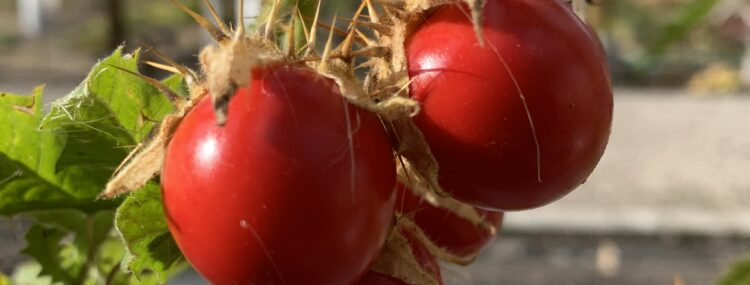
- Morelle de Balbis – (? aka Litchi tomato, aka Solanum sisymbrifolium). Known in India in the 1500’s, but originated in South America. Closely related to the eggplant & potato….that is why the potato beetles love it! A wild species that will grow from 24” to 5 ½ feet, depending on the nutrition in the soil. The entire plant is heavy with thorns everywhere…back of flowers…on stems…and under leaves. Even the leaves are different, looking like small oak leaves, but with prickers…top to bottom! If kept small, one main stem will form. If allowed to grow huge…several (about 5) main stems will form from the base of the plant. If kept small, fruiting will begin early and mature in time before freezing. If you feed it too much….you will have a wonderful show of beautiful blue flowers, but the fruits will not be able to finish. ALSO…plants left in the garden have been able to tolerate -6C and thrive! Fruit flavor is a blend of mild sour cherries and tomatoes! They are also different in appearance… 1″ deep scarlet red, chubby ovals, with a point…like an over-stuffed “Micro Tom” tomato. (see photos in Flickr...) They are heavy producers, no matter what plant size they are at. Unusual variety and well worth growing for a novel experience. Suppliers claim to pick the wee fruits straight off the plant and eat them like candy. ($10 to a doughnut… they’ll get poked!) Determinate, depending where you grow it! ? 70-100 days Pkt…$3.00
- Mr. Jack – named after Jack McDavid, a restaurateur of Philadelphia, who cooks for his patrons in bibb overalls. This tomato was developed by crossing “Zapotec Pleated” with a “Red Pear”. The resulting fruits are quite large, having the heavy ruffled ribs of the “Zap” and the scarlet red color of the “Pear”. The flavor is greatly improved over others in the “Ruffled” series because of the “Pear” influences. The walls are very thick and the resulting meat is quite excellent in sauces. Williams Woys Weaver promoted it in later years. Plants are also strong growers and heavy producers. Ind. 85 days
- Orange Centiflor Hypertress – Developed by Peace Seeds of Corvallis, Oregon. See #38…a “Red” version…for more info. Limited Pkt…$3.00
- Orange Fleshed Purple Smudge – W0w! The most unique tomato var. I have ever seen! I have grown it’s “cousin”…”Purple Smudge“, so knew a little of what to expect, BUT was not prepared for this one. This stunning vibrant orange flattened tangerine was brushed with deep purple streaks on its cheeks, near its stem end. Its flat shape, gentle ribbing (in some fruits…) and purple “painted” pigment made it the most photographed variety at our G.H. Flavor is pleasantly sweet, almost fruit-like. Flesh was amber/yellow/orange (all of my favorite colors!) In ’09…producing modestly in clusters of 3-5, with fruits weighing in at 5-10 oz. Started out mid-season and then would not stop till freeze up. Ind. 75-80 days Pkt…$3.00
- Peach Jaune – a winner from our “down under” Australian friends! Small to medium sized (3-8oz), round, thin-skinned, pale yellow/amber fruits with fine “fuzzy” laced skin. Some show a hint of pink in the blossom ends. All agree it is a most fruity variety with apricot-like flavor, modest sweetness and lots of seeds. Taste tests agree to a 9/10. (Could this also be called “Peach Blanche”) Ind. 80 days
- Pink Fuzzy Boar – Well what’s with the word “Boar” affixed to this name? Word has it: A gentleman by the name of Brad Gates is known as the “tomato guy” in the California Bay area. He has become famous for his work growing “those weird non-red tomatoes” after he became fascinated with the farmer’s market scene. He is also the proprietor of Wild Boar Farms near Napa, California. His main focus is bi-color and striped varieties with extreme flavor and fascinating looks. […c/o BC seeds] You will see many new varieties of his, in years to come AND a ton of great varieties have already been distributed…unpatented! Another of his lines are the “Berkeley Tie Dye” series! This “…Fuzzy Boar” variety offers strange pink fruits with a light coating of peach “fuzz”. Medium in size (6 to 8oz) these gorgeous fruits offer light pink, dark pink, cream and white striping! A “heavy” weight with sweet tangy tomato flavor. Many claim these to have thin skin too. Ind. 76 days Pkt…$3.00
- Pink Stripe Gold – Well…talk about a huge pastel orange beefsteak! I do see fine lines but it was its flavor that shook me. For one of this type, smooth acid sweet balance and delicious. Plants aren’t too tall and this one bore 1-2lb’ers all summer long till fall…for the entire duration. Pkt…$3.00
- Pixie Striped – Here is a nice small plant offering up nice small to medium sized, ball shaped, juicy yummy (real tomato) fruits in a wonderful red and yellow stripes. Have to try and see… Pkt…$3.00
- Primary Colors – Not sure about the history… This one is so bizarre, I can not believe it! How about bright yellow with white & dark purple/blue striping…only on the skin??? Each fruit is different, one from another. Not your biggest beefsteaks but certainly one you will remember! Their tropical “blue” look can be enhanced with loads of sunshine! Flavor is mid to medium flavorful. Great for low-acid eaters. Ind. 70 to 75 days
- Purple Bumble Bee – Aw such cuties! A few can fit in the hand but what is interesting are their coloration: on scarlet deep red base, are purple/green jagged stripes mixed occasionally with a bit of cream and spots. Flesh inside is dark green black and these just explode in one’s mouth! Very juicy despite our dry summer. Limited Pkt…$3.00
- Red Centiflor Hypertress – Bred by Peace Seeds of Corvallis, Oregon. According to Alan Kapular, seeds of Lycopersicon humboldtii were obtained from Rose Marie La Cherez of Australia. His daughter was experimenting on cross pollination of peas (and some other vegetables) and asked to work with this particular variety. She then crossed it with a Lycopersicon hirsutum, an 8 ft.tall variety. The result was an outstanding hyper trussed red cherry variety that has a reputation for producing as many a 150 per truss in a good garden! Not only that…one plant will go on to produce several of these! Can you imagine? Pkt…$3.00
- Red Stuffing – H.H. Seeds obtained this one from an elderly lady who grew it in her garden for many years. The fruits start out as 3 to 4 lobed perfectly shaped chubby peppers with hollow centers, having their seeds clustered in the very middle. As they ripen, they become mostly red, some turning rose/purple. Bushy vines have regular leaves. Ind. 83 days
- Red Velvet – (aka Velvet Red) See description below…
- Red Viper – Didn’t manage to get a whole lot of these so supply is limited. Skin is brilliant scarlet red and flesh is actually bright yellow with dark emerald green seed pockets. Fruits are only about toonie sized to 4oz. on smaller plants. Limited Pkt…$3.00
- Red Zebra – One cannot decide whether this fruit is “Fire Engine” red with yellow stripes or “Hot” yellow fruits with red stripes. You need to grow this one to find out the answer to this riddle! Yellow stripes will deepen to orange when the fruits are real ripe. Fruits will be the size of a tennis ball of 2 ½”, perfectly round and the flavor is a nice acid balance with good juiciness and many seeds. Not as productive as “Green Zebra”, but extremely popular with customers at Farmers’ Markets. Some growers remarked that production increased under cooler weather. Plants show some disease tolerance. Ind. 85-95 days Pkt…$3.00
- Riesetomate – (aka Riese Tomate, aka Reise Tomate, aka PocketBook) A suggestion that it may have come from the Indians of Central American Plains, who referred to one called the “Traveler Tomato“, because it could be eaten by bites, a few at a time, without getting rotten! Another suggests it is a German heirloom. Hummm? Here is the 3rd in a partnership with those in the “Weird” tomato category. I just love it! This plant forms, what could only be called tomato fused clusters! Each individual tomato is a masterfully assembled cluster of fused together grape-like sections! (see photos in Flickr...) Don’t bother to peel it…..you won’t get anywhere! Just gently pull apart each grape-like section much like you are pulling off segments of an orange! The flavor is like an old-fashioned real acidic tomato. The first plant that I trialed years ago, was mistakenly (by me…) planted in rich soil. Never again! It grew and grew and grew! By the time fall rolled around, I had about 6 (6ft) branches, all beginning from the very same base. The red fruit was endless! Be warned…plant it in lean soil. Ind. 80-90 days Pkt…$3.00
- Rose Quartz Multiflora – (There is a slightly larger tomato called Rose Quartz) This version is a multi-flora/branched version of it. [Said to have been grown out by the Tomato Fest Seed Co. wh0 obtained the original source from a specimen located in the Rhode Island garden of Carolyn Curry, Massachusetts in 2002… Tatiana’s Tomato Base] A deep pink cherry of aromatic fruity flavor, that produces 100’s of small fruits in trussed-profusion!
- Ruffled Pink – (aka Pink Ruffled, aka Pink Accordion) Fruits are exactly as the yellow variety described below, except these “colored” ones end up a soft dusty pink when ripe. Flavor is mild and sweet. Texture is very smooth. The “ribbing” on these are far more pronounced than others in this series…”Tlacolula Pink” and “Zapotec Pink Pleated“. Plants are quite aggressive, growing to 4 ft. and their production is huge. Ind. 75-80 days Limited Pkt…$3.00
- Ruffled Red – (aka Red Ruffled, aka Red Accordion) Fruits are exactly as the variety described below, except these “colored” ones end up a deep scarlet red. Fruits are mild and texture is smooth. Huge 6 ft. vines, their production is the highest of all 3 “ruffled” relatives! Check out another cousin…”Mr Jack“. Ind. 75-80 days Pkt…$3.00
- Ruffled Yellow – (aka Yellow Ruffled, aka Yellow Accordion) Wow! What a beautiful variety! A brilliantly pleated yellow/gold tomato. These fruits have 10-12 ribs with one large seed cavity. The yellow gel within has a sweet fruity with slight tartness flavor. Fruits are known as semi-hollow (for stuffing), growing about 3″ to 4″ across and about 2 1/2″ wide & deep. Skin is thicker (won’t break down with heat) and flesh resembles a Roma. When the “pulp” is scooped out, these “boats” make perfect vegetable containers. OR…slice it across and display the ruffled slices on a plate to impress your guests. This will surely knock the socks off any connoisseur! (See photo in Flickr…) Plants did not grow too tall and fruit production was super heavy in 2011 plant trials. The condition called “tomato blossom end rot” which I have experienced in other years, with this variety, I have finally managed to root out! Ind. 80 days Pkt…$3.00
- Sargent Pepper – Hummm! Here is a rare beauty, ranging mostly from medium to large. Plant leaves and stems are some of the darkest purple shading that I’ve ever seen! Fruits, as stated are mostly heart shaped, with a dark pink pretty base, accented by deep purple shoulders. Leaves are frail and I’m thinking this one isn’t going anywhere..but look out! Late season they suddenly showed up and what a bunch there was! Excellent flavor. Pkt…$3.00
- Scabitha – Wow for this one! Perfectly round/oblong, medium sized (5 to 7 oz.) fruits with the most unusual bright striping of orange/yellow on red, radiating from stem to blossom end. Skin has a “raised netting effect”, giving a rough feel. Very juicy and tasty. In trials of 2013, this one’s flavor was tangy & sweet! Production and earliness was outstanding! Plants stayed small, only about 24″. Very rare. Ind. 70 days
- Siberian Speckled – a fantastic Russian heirloom, looking similar to the now extinct “Crimson Cluster” tomato intro. in 1869 according to H. H. Seeds. A very productive variety in ’09, offering up 9-14oz. red fruits covered with tons of tiny flecks of Gold! No 2 were the same! Plants grew from 4 to 5 feet. Ind. 68 days
- Silvery Fir Tree – From “Russia with Love”! Now here is a tomato variety that I encourage you to grow in rich soil. The little ones I tested were fabulous! They grew only to 18”, being crowded out by their neighbor…“Reisetomate”! The fruit production went crazy….these wee plants had only about 4 large clusters in total, but each cluster contained close to 20 fruits each, with each fruit being about 3-7oz! Unusual, too was the foliage on this variety: “carrot-like”, delicate, lacy, dissected and frail-looking. Can’t say enough about the fruits, which were scarlet red, juicy and with great full-bodied old-fashioned tomato flavor. (Ok, so I am in love with it, so what!) Oh! One more thing….pick every fruit! Volunteers will gladly come up next spring…making it in time for ripened harvests! Determinate 50-65 days Pkt…$3.00
- Speckled Roman – (aka Striped Roman ? ) Original seed (they say…) came from a variety found in John Swenson’s garden. A possible crossing result of 2 heirloom varieties, “Antique Roman” and “Banana Legs”. Very productive plants, growing not too tall. A lot of growers are having varied results with this one. Fruits range from 4”-5” long x 2” wide OR ….6-8oz in weight. The flesh of these are very meaty, yet smooth textured, thick with few seeds. The flavor is sweet, mild with some juice (unusual for a Roma). The color is striking….carrot-shaped plums, with orange and scarlet red jagged stripes running down their length. Loved by chefs, looking for a perfect size, brilliance, meatiness and flavor! Keeps well. Ind. 75 days
- Spoon Tomato – So I had to grow this to see what all the fuss was about. Darn it! I’ve never seen such tiny pungent fruits on equally tiny wiry plants no more than 16″ tall. Loaded little buggers too! Oh and they are orangy red!
- Stick – (aka Curl) Me think’th I have secured the most bizarre tomato of them all! [Developed by Young, P. A., Tomato Disease Laboratory, Agricultural Experimental Station, Jacksonville, Texas…Young describes a dominant mutant which he termed Cu or Curl and which he located in 1953 as a mutant on a plant of the “Stokesdale” variety. Because the vines are distinctly non-suckering in type, Gleckler Seedsmen of Metamora, Ohio, listed Cu in 1959 as “Stick“…c/o “Tatiana’s Tomato Base”] SSE Tomato 361 Stems are to perform like actual sticks, growing to 3 and even 6 ft! Leaves are tight clusters of curled pom pom like green structures. Fruits range from 5 to 7 cms or 1 to 3 oz of red with yellow skin. Some say flavor is modest, others say quite acidic and ok. Can be grown in pots, BUT must be staked! Thanks Ken!
- Striped Cavern – Vibrant colorful rose/red fruits with bright yellow and orange blending. Stunning! Visually, a chubby, with slightly pointed ends, bell pepper with thick walls and a nucleus of seeds. Fine flavored. Super great for cold or heated food presentations. This variety, seems to mature later than my other Striped Hollow” variety. Ind. 80-85 days
- Striped Hollow – (aka Schimmeig Stoo) Thanks to Tammy C. It was developed by Tom Wagner, who named it after his grandfather, being from the Isle of Mann. It originates from 4 heirloom lines. Another in a series of hollow “stuffing” tomatoes. Well…my plant trials of 2011 made a liar of me! (From a previous trial in 2006, plants only grew to <24″! Must have been the 80 foot Cottonwood towering overhead…) Plants had no problem reaching 6 ft. Production was terrific! The fruits were medium to large sized chubby flat bottomed (just like!) bell peppers. The colors were very interesting: bright scarlet red with iridescent orange/yellow jagged stripes running length-wise. Inside, one finds several lobes from 3 to 4 in most cases. The seeds are huddled together in the very center, making them easy to remove. The taste is better than normal making these a great choice for baking. Thanks to my friend Tammy C., I have the correct form back again.. Ind. 75-80 days Pkt…$3.00
- Tigerella – From England ? Produces beautiful “tooney” sized round fruits with red and orange skin and gold/green/yellow jagged stripes. Flesh is meaty, reddish/orange, juicy, brisk, tangy and tart. Skin is very thick. Perhaps an ideal storage tomato. Plants are vigorous, but not too tall. Production is medium. Ind. 55-75 days
- Tiger Stripe – see “Tigerella”
- Tiny Tiger – originally obtained from Reinhard Kraft of Germany. Dwarf 18″ plants produce loads of 2″ orange and red striped, chubby/round fruits. These fruits offer excellent flavor…a sugar/tangy bite of pure perfection! Their size is perfect for decks and small gardens…or where ever you want to place them. Their fine stems and leaves form a neat tangled mass of interest. Different! The books say that this one is Indeterminate. Mine behaved as a Determinate…bushy tree. 70 days
- Tlacolula Pink – (aka Tlacolula Pink Pleated, aka Tlacolula Pink Ribbed) Magnificent heirloom collected by a friend to BC seeds in Tlacolula, Mexico. These actual, pear-shaped fruits have deep ruffles and ribs giving them an unusual appearance. Fruits are deeper, girth wise, than the “Ruffled” series…..and the ribs taper and smooth out running to the top. (See photo in Flickr…) Fruits are velvet rose pink, with occasional pale green/yellow shoulders. Their size ranges from 5” across to 3” wide and 3” deep. Most have a small hollow center, with thick walls, good juice and quite good flavor. Plants are very healthy and vigorous. Ind. 75-85 days Pkt…$3.00
- Turnadot – I just had to mention this weird one (…you all know I love “weirdos”!) here, and hummed and hawed a bit but left it in the Roma Section, strictly for its strong roma like texture & flavor! BUT! It is a strange shaped one indeed! Check out photos on Facebook (Mandy’s GH) Pkt…$3.00
- Variegated Tomato – (aka Splash of Cream) This variety may have origins in Ireland, but has been grown in extensively in England & Western Europe. A French person had received this one as “Variegated”, but changed the name to “Splash of Cream”….so I remain true to the original! Truly amazing! A variegated (cream splashed) form that comes true from seed. When several are grown together, there is a definite difference between different plants with some having more variegation than others. It would be worth it to grow these out and collect those that retain the most color in the most adverse conditions. It is common knowledge that the hot sun turns off most variegation. However, the sun DID NOT effect this variety as I found out trialing it in 2009! Foliage and stems are cream with dark green. My plants were stocky and vigorous. Plants bear tasty round scarlet/red fruits of 3-4oz that are not too sweet. Believe it or not, these fruits started out dark green with white stripes before they begin to ripen. Once ripe, most of the stripes disappeared! As with the “Lutescent” variety, some fruits on the same raceme will ripen sooner than others…causing different colors to be showing at the same time. Clusters of 6-7 per raceme, are not uncommon. It is quite a sight to see deep red fruits against silvery white and emerald green variegated plants! Semi-Ind. 70 days Pkt…$3.00
- Velvet Red – originals from the S.S.Ex. Foliage is unique with a heavy “Dusty Miller” look of silvery blue-gray. Plants offer heavy yields of 1” vermilion red cherry tomatoes with excellent sweet concentrated flavor. (See photo in Flickr…) Fruits are gently fuzzy, but not “furry”, as the “Fuzzy Peach” tomatoes. One of my personal favorites to look at in the garden. Ind. 75 days Pkt…$3.00
- Velvet Yellow – Arrived on one plant, in a trial grow out of the red version last year (2012) Appeared to be a “Somatic mutation” according to my research. Whereby one entire branch (of 3 branches starting at ground level…) showed only yellow fruits. Grow-out for several summers, proved this one remains STABLE! Nice! In 2014…grew 16″ tall with the typical “fuzzy” stems and leaves. However in 2020, no problem reaching the typical 4ft! Very Rare! Pkt…$3.00
- Wapsipinicon Peach – this Iowa heirloom is named after the Wapsipinicon River. The fruits are small…2” and the skin is thin and gently fuzzy. The color is light creamy yellow, almost white. The taste is just superb….a complex ambrosia of spicy, sweet and very fruity. The best many have ever tasted. Plants are devoted producers. Smaller in stature than “Garden Yellow Peach“. Determinate 75-85 days
- Yellow Centiflor Hypertress – Back for 2024! Developed by Peace Seeds of Corvallis, Oregon. See #24….”Red” version…for more inf. Pkt…$3.00
- Yellow Tiger Stripe – Very similar to “Tigerella” (aka “Tiger Stripe”) Stripes and base colors are more yellow and green, than its cousin. Fruits are juicy, with rich flavor & also appear to be larger than the other varieties mentioned. Plants are not tall, averaging about 18″ overall. Leaves, if I recall appear slightly more frilly? Ind. 76 days Pkt…$3.00
- Yubileyny Tarasenko Red – (aka Jubileyni Tarasenko) Ukrainian heirloom developed in 1987 by the famous Soviet tomato breeder Fedor Tarasenko who celebrated his 75th Anniversary in 1987 and therefore named it after his jubilee. From Lyuda Battin. This unusual variety bears scarlet red fruits of 120-160 grams that are round & “egg-shaped” with heavy fleshy pointy ends. (See photos on Flickr…) Most clusters bear from 4 to 10 with reports of monster clusters offering up to 25! Good old fashioned flavor. Plants are very productive! Will grow to 6 ft or more. Long season production. Ind. 70 days Pkt…$3.00
- Zapotec Pink Pleated – Back for 2024! Heirloom from the Zapotec Indians. Beautiful heavily ribbed dark pink, pleated fruits make table settings very ornamental in appearance. Excellent hollowed and stuffed or sliced to show off its shape. Sweet and mild with very prolific yields. Large fruits of 9 to 14 oz. on large plants. Ind. 80 days Pkt…$3.00