
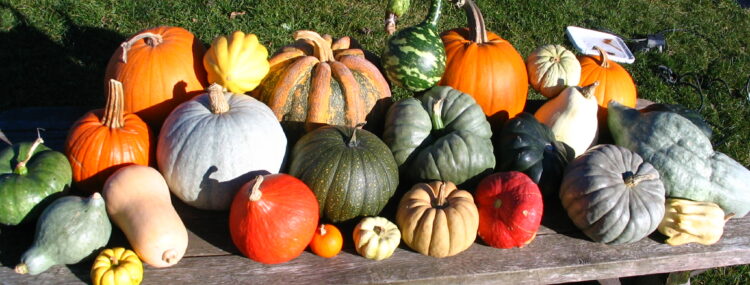
Squash (Winter)
Welcome everyone to the exciting world of Squash! We will never get tired eating any of these varieties, in so many ways. From the ultra sweet and rich (for winter) to the mild (for summer)…something for someone!
Will remain online for educational purposes. Operating on a “Hobby” basis.
Occasionally we may have extra seed. Pkts. marked below. If nothing marked…then it is “N/A”.
- Arikara – originally grown by the Arikara Indians of North Dakota. This shape is oblong with pinkish/orange skin and a greenish star at the bottom end. The squash flowers were used by the Mandan, Hidatsa and Arikara tribes. Be sure to pick some male blossoms as they can be dried for winter use. Excellent for storage. 90 days
- Banana Pink Jumbo – From 1900’s. A long submarine-shaped variety with unusually pinkish, tan, whitish, very smooth outside skin. Fruits grow to 24” long! Flesh is excellent, sweet, dry, fine grained and light orange. Would make very tasty rich pumpkin pies. Wonderful storage qualities.
- Blue Bullet Hubbard – (aka Baby Blue Hubbard) A sweet scaled down version of the huge Blue Hubbard. This one is more marketable and easier to transport. Smooth-skinned, blue-grey fruits are medium sized… 4-6 lbs with sweet bright orange fibreless flesh. Stores just as well as the big guy. Yield 3 per plant. 95 days
- Blue Hubbard – (aka New England Blue Hubbard) Here is the Big Guy…an outstanding “winter” squash of 13-15lbs…very reliable. Heavy feeder, needs some room! Tear-drop shaped, deep dusty blue, semi-bumpy hard skin, excellent in storage (mine is still around…now in its 2nd winter!!). Flesh is orange, rich, thick and sweet. Excellent in pies or cut into servings and baked. Also great steamed, boiled and mashed. Reduce sugar! 100 days
- Bush Buttercup Squash – Like a standard buttercup with sweet dry orange/yellow flesh of excellent qualities…but these are produced on “Bush” plants of only 3-4ft in diameter! Compact! Fruits are 3-4lb, dark green-skinned. Excellent for small gardens. 95 days
- Bush Delicata – dev. by Dr. Molly Jahn. (Others say that this heirloom was intro. by Peter Henderson & Co. in 1894) Medium sized elongated ovals with alternating large white broad bands with narrow dark green stripes running down its length…which become yellow in storage. Flesh has high sugar content. Plants grow on semi-bush type vines and are powdery mildew resistant. 100 days
- Chicago Warted Hubbard – As the name implies…a warted big Hubbard!
- Flat White Bob Ford – As in some parts of the world, pumpkin is a staple in South Africa. This variety is a favorite, treasured for its bright orange flesh, sweet flavor and firm, slightly dry texture. This heirloom pumpkin has a flattened oval shape and a tough, creamy-white rind that makes it a true keeper. Plants are both vigorous and prolific. (thank you Alan Reynolds in Africa, for sharing this variety…) 110- 120 days
- Flat White Boer (Van Niekerk) – Ah…another legend from South Africa. Seems this one starts out pure white and matures to beige with a pale pink netting. Said to reach 12+ kg’s! Has the shape of a flattened wheel, with mild ribbing running down it. Flesh is rich, deep orange, dry and very sweet. (orig. from Alan Reynolds in South Africa…with thanks)
- Fordhook Acorn – Intro. in 1890 by W. Atlee Burpee of Philadelphia. Said to be named after the Fordhook trial fairgrounds at Doylestown, Philadelphia. A very versatile squash, being used as a summer variety (boiled or fried) or left to mature more and used (baked) in winter. The beauty here…it does not get huge, reaching only 2-3 lbs, with lovely beige/tan mature skin and heavy ribbing running down its length. 110 days
- Galeux d’ Eysines – seed collection by Amy Goldman from La Ferme de Ste. Marthe, Cour-Cheverny, France. 1st seen at the Pumpkin Fair in Tranzault, France in 1996. Fruits weigh between 10-20 lbs with sweet orange moist flesh. The skin color is tan/pink and the shapes are round & flattened. Great for baking and soups. Should be harvested before overly mature, because the peanut-like warts continue to grow and will cover the entire fruits. Excellent for table center pieces in the fall. 9
- Gill’s Golden Pippin’ – Almost lost BECAUSE some of bad business decisions! Dev. by Gill’s Brothers’ Seed Co. possibly well prior to 1955…as it was highlighted in their 1960 catalog. A golden acorn that has a heavy fruit set AND ripens early. For an acorn, extremely flavorful: nutty and sweet. Anyone who has tried it…says so. Simply cut in half, scoop out the seeds and fill it with your favorite filling and roast away…
- Golden Delicious – A gorgeous variety introduced by Gill Bros. Seed Company of Portland, Oregon in 1926. Lives up to its name! These fruits are tear-drop shaped and weight about 7-9 lb. The rind is a brilliant orange and the flesh is very smooth when baked, orange and tasty. 100 days
- Golden Hubbard – Introduced by D. M. Ferry in 1898. Typical hard-skinned (winter) hubbard with skin color a beautiful deep orange. Fruits weigh 8-12 lbs. and have thick, dry, sweet, fine grained golden/yellow flesh. An excellent keeper and roaster. 90-100 days
- Guatemalan Blue Banana – Looks sooo much like the Banana Pink Jumbo and was my best producer for this year (’15)! Love those elongated (16″ x 5″) beautiful fruits! Young fruits start out a light green and mature to a lovely slate baby blue. When I wrote this (Oct.12th, 2013) I still had 3 perfect specimens, whole and complete in my basement, grown out the year before!
- Hooligan (M’s) Squash – Obtained this one thru a friend in the Anola, MB area. Plants are large and very productive. Fruits are perfect for single servings. A novelty miniature squash/pumpkin. Just lovely to look at and tasty too. See photos on Flickr or in my Album. 90 days
- Honey Boat Delicata – (aka Sugar Loaf Delicata, ?aka Candystick Dessert Delicata ) Selected in 1992 from a “Delicata” heirloom of 1894 (as a variant that proved to be stable) Vines grow to 12 ft…so give them lots of room and lean soil. Each squash makes about 2 servings for a small family. Fruits are elongated, yet chubby, with wide ivory and deep green stripes running lengthwise. Ivory as it ages, will turn tan color. Mild flavor with yellow/orange flesh. Beautiful and easy to grow. 100 days
- Jarrahdale – A heirloom from Jarrahdale, Australia. Here again another deep slate blue, smooth skinned variety, having a flattish form and ribbed exterior. Fruits can grow to 8-10 lbs (10′ x 14″) perfect for a family of 4. The true form offers “dry, stringless, highly fragrant flesh which is sweet with a complex flavor”.
- Kikuza – introduced into the seed trade as “Sweet Kikuza” in 1927 by the Oriental Seed Co. of San Francisco. Very beautiful, thick-fleshed squash with excellent eating properties. Fruits are round with indented tops and heavily ribbed. Skin color is a pretty tan/pink/grey. Weights are about 5-7lbs…perfect for roasting for a modern family. 90-95 days
- Kuri Red – (aka Orange Hokkaido, aka Baby Red Hubbard) Japanese squash has a tear-drop shape with modestly smooth skin and textured sweet orange flesh. Can become 4-10lbs. Great winter keeping variety. High yielder. Another fall decorator. 92 days
- Little Gem – continuous production of immature fruits for use as summer squash. Mature fruits are large softballs in size. Final color is a brite orange. Great keeper. Could this be the one that Mr.Jack brought over from the British Isles over 30 years ago? Has a slight teardrop shape.
- M’s Pink Ghost – Found 2 plants bearing this unusual “cheese” type of heavy fruits. Flesh was real thick. Skin was very smooth, bore a pale pink (ghost like) sheen over gently waves of ribs, something like the “Musque di Provence“. Just had to save it and now we will both find out next year, if it continues this genetic adventure.
- Marina di Chioggia – an old fashioned heirloom “Sea Pumpkin of Chioggia” originated on the coast of Italy. Fruits are turban-like, large (10lbs), black/blue/dk. green ribbed skin, with numerous warts and bumps growing on the surface. A button forms on the blossom end. Rind could also be described as blistery, bubbled slate blue/dk. green. A wild, yet subdued addition for fall ornamentation. Delicious! Great for gnocchi and ravioli. Each plant bears only 2. Tolerant of most weather. 100 days
- Mini Red Turban – (aka Small Chinese Turban) Documented in Vilmorin’s “The Vegetable Gardener” (1885) Brilliant reddish/orange small turban cap squash. Uniform size of 6” to 8” of the very best quality flavor. Folks have found it to be one of the most prolific of all varieties. 80-100 days
- Musque de Provence – See description in our “Pumpkin Section“…
- Naples Long – An unusually large & long “tear drop” type. Skin is striped dark and light green. Flesh is not too rich and plants produce several per vine.
- Pennsylvania Dutch Crookneck – One of a kind…enormous 10-20lb fruits. Easy to prepare as the curved neck is completely filled tight with sweet dark orange flesh. Just cut into rings and bake. Seed is all contained neatly in the bottom of the fruit. 100-110 days
- Queensland Blue – a winter heirloom squash obtained in 1932 from Australia. A beautiful blue skin deeply ribbed around the sides, but flat on the top and bottom. 12-20lbs. (other say 6-8lbs…) when mature. Excellent storage ability. Flesh is once again thick, dense, semi-sweet and very tasty. Yields are 2 to 3 fruits pre plant. 100-120 days
- Red Warty Thing – (aka Victor) Intro. some years ago by Rupp Seeds as “RTF” after receiving some seeds from the USDA. However what they received was incorrectly labeled. After doing some research, Amy Goldman believes this variety to be the actually true “Victor”. a variety intro. by Gregory’s Seed House in the 19th century, after Mr. Gregory saw this variety at exhibition @ county fairs. The round fruits are brilliant scarlet & completely covered in bumps. Stunning to look at and a “must have” for fall decorations. Tasty flesh. A quick seller @ garden markets.
- Sibley – (aka Pike’s Peak) ? orig. with native Americans or even Mexico. Grown extensively in Missouri & Iowa in the early 1800’s. Intro. into the commercial trade by Hiram Sibley & Co. of Rochester, New York in 1887. Vines will reach 12ft. Another slate blue var., of 6-8 lbs. in a tear drop shape. Do not harvest and eat too soon. Folks say that it only gets better “with age”! Rich, moist, flavorful and sweet.
- Silver Edged – (aka C. argyrosperma) A rare find. Grown primarily for its seeds…which are very large, white and with a silver edge! Beautiful! The fruits are also strange…being like a squatting plump pear/round, with dark green and white stripes. Have been told the pale flesh is almost tasteless. Some say…fit only for chickens! Is very tolerant of adverse weather. Popular with Latin Americans for some time.
- Sugar Loaf Delicata – see above description…
- Sweet Dumpling – Single-serving small beautiful fruits. Lovely ivory colored with wider dark green stripes…acorn styles. Round flat-topped shape…for stuffing. Yellow/orange flesh is sweet and tender. Can store for 3-4 months. Short vines yield 8-10 fruits. Requires no curing. Do not wash with soapy water as this will remove the protective natural coating that storage requires. Just remove dirt with a dry cloth when very dry. 90 days
- Tan Pink Butternut – Attractive butternut that most groceries now carry. Average weights are usually 2-2 1/2lbs that if cut in half, will easy make one serving for a person. Excellent for baking and pies. Yields about 4-6 per plant. 105 days
- Tennessee Sweet Potato – Gosh! How could I have forgotten to list this one? History says: Originally listed in 1847 by Seedsman Grant Thorburn of New York, as “Green Striped Bell“. Seems that when Burpee later offered it in 1883, they may have changed the name to what it is known as today (..c/o New Hope Seeds) It is a large cream/white 10-15 lb pear shaped squash, bearing a faint light green stripe. Flesh is said to be light colored, fine grained and dry…like roasted sweet potato flavor, maybe reason why the name was changed?
- Thelma Sanders Sweet Potato – Heirloom intro. from 2 Ohio S.S.Ex. members Tom and Sue Knoche…squash specialists. Cream/tan colored acorn type fruits that will make a 2-person serving. Trailing short vines are very productive. Bushy! 85-90 days
- Tonda Padana – A heritage cooking variety with dry sweet flesh that is excellent for pies, soup, gnocchi and breads. Near maturity, reduce water as this causes watery flesh. Harvest when the skin cannot be pierced with a thumbnail. Leave outdoors (in a dry, windy, covered shed) for several weeks to cure, before taking them into the house. What a strange one…kind of “antiqued” ! (Look in Photo Album) I found in my trials it was way larger than I expected! No problem reaching 8-14 lbs.! In January, it is just starting to soften its skin. Cutting it was a breeze. 85-95 days
- Triamble – (aka Triangle, aka Tristar, aka Shamrock) Extremely rare. First found growing in 1932 in the US. Seed was obtained from Arthur Yates & Co. of Sydney, Australia. Very thick flesh (small seed cavity). Excellent for pies, baking as is or as a vegetable summer squash. Excellent long storage. In its trials, it produced more per fruits per vine than most squash. Just love that shape and “ghostly blue” color! 115 days
- Turk’s Cap – (aka Turk’s Turban) Intro. in 1869 as American Turban. Forms a distinctive cap or turban. Fruits grow to 8” -12” diameter and weigh up to 5 lbs. If not bruised, will last 3 months in winter. Fair for eating. Excellent decorations for the fall table. Great as a roadside market fair. 80-100 days
- White Acorn (Bush) – a lovely, almost snow white fruited squash. Heavy yields of beautiful fruits produced on compact “Bushy” plants. Small gardens will love this one! This superb acorn is mild-flavored. Was developed in the early 1980’s by Glenn Drowns.