
Ground Cherry
The last 5 years have seen an steady increase in the demand for Ground Cherry (Husk Tomato) varieties. If my grandchildren are any indication, your grandchildren and the “child” within you will love these. They are sooooo good! Nothing like opening up a “present”…of sweet fruits!
Will remain online for educational purposes. Operating on a “Hobby” basis.
Occasionally we may have “extra” seed. Pkt. marked below. If nothing marked…then it is “N/A”.
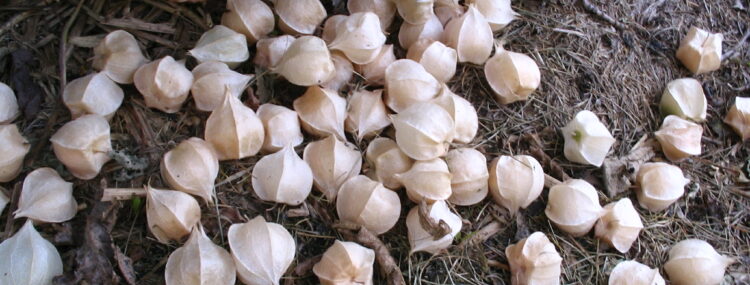
- Ground Cherry “Aunt Molly’s” – Heritage variety from Poland. Recorded as early as 1837 in Pennsylvania. Plants grow from 21/2 ft to 2 1/2 ft…sprawling habit. Fruits are encased in paper beige husks when forming, staying closed up right till their ripen stage. Fruits can be 3/4″ in diameter, golden when ripe and left stored in these husks without spoiling for 3 to 4 weeks. They can be eaten right from the plant when ripe or made into preserves or pies OR cooked down and ladled over ice cream! Yum! Fruiting starts by end of July and continues right up till frost. 70 days Suggestion: Once the ground has warmed, place thin landscape fabric down around the plant base. It will heat up the ground (increased production) and keep the fruits clean for picking. Pkt…$3.00
- Ground Cherry “Cape Gooseberry” – (aka Physalis peruviana, aka Goldenberry) is a large sprawling 3-4 ft. plant with downy (hairy) leaves. Production is not quite as heavy as the a-fore mentioned AND it will traditionally ripen later than all others. Short lived perennial in its native tropical America. A heavy producer of dark gold large 1″ sized fruits, encased in a larger, slightly elongated, beige, papery husk. Fruits are flavorful and sweet, very refreshing! Can be used fresh or dried, as “raisins”.
- Ground Cherry “Cossack” – (aka Pineapple Ground Cherry, aka Physalis pubescens) Close Cape Gooseberry relative. Plants bear many sweet flavored fruits, with a pineapple like overtone. Can be eaten raw, cooked or dried. Will store for several months (as I found out after forgetting them in my small G.H.) Found them to be absolutely delicious! Sooo! Dry away! Tasty fruits ideal for a fruit-based dish or chutney. AND little grandchildren LOVE’em too! Plants can reach from 2 to 3 feet. 75 days
- Ground Cherry “Goldie” – (aka Physalis pubescens) A prolific ground cherry variety with golden yellow, medium sized fruits. This variety grows slightly larger than its cousin, the “Cossack”. Plants said to reach several feet. Pkt…$3.00
- Ground Cherry “Yellow Husk” – (aka Physalis pruinosa) Variety offers medium sized golden fruits. Said to have a citrus/sweet flavor. Plants slightly smaller than “Aunt Molly’s“, growing from 18” to 2 1/2 feet.
- Ground Cherry “Yantar” – means “amber” in Russian. Dev. by Belarusian Res. Inst. of veg. Gardening. Very rare. Another variety similar to the Cossack Pineapple type. This variety offers cherry sized fruits of exceptional flavor, ripening to a golden orange. Plants seem to be the smallest of all the varieties that we carry, low growing shrub, spreading only from 6 to 18″.
- Ground Cherry “Yellow Nightshade” – (aka Physalis crassifolia) Sais to be a native originally from the deserts of the American Southwest. Grows wild from Utah thru California & South to Arizona. This wild variety’s form is small, from 12″ to 18″. Fruits are smaller that others, light yellow with papery husks.
- Garden Huckleberry – Native to Western Africa. Plants become very large, 3 x 4ft., sprawling if soil is too rich. Unusual in that developing fruits are like open grape clusters… green at first. Later ripening to a deep purple/black, producing hundreds of shiny 1/2 – 3/4 ” fruits. Tasteless when raw and not sweet. BUT makes delicious mock blueberry pies and preserves! ( Folks who have tried them…say indeed like a blueberry pie! Check out (“Huckleberry Pie” in our RECIPE section) Great when frozen or canned. Best picked when berries turn from glossy to dull black. It is common to think that this one is poisonous. Countless studies have proven their safety. 75-80 days. Pkt…$3.00
- Sunberry – Bred in the early 1900’s by Luther Burbank. Is a cross result of 2 wild species, one from Africa & the other from Europe. (See more of its history @ S.S.Ex. US) A small shrub-let, 24′ x 24′, having all the gently fuzzy appearances of its cousins…the tomatillos, but with the “airy” structural growth of the “Garden Huckleberry”. Its fruits are smaller, deep blue, with more taste ripe than the “Huck”. Would have no problem eating it right there…unless I shouldn’t! If Canola beetles are a problem in the area…these will fall victim, unless you throw a light cover over it!
- Tomatillo “De Milpa (Purple)” – These grow unattended in Mexican corn fields. Higher dry matter, round purple fruits store for several weeks in baskets or with the husks pulled back and strung like garlic. Best in fresh salsa. Fruits are green with a heavy purple overcast. 70-80 days
- Tomatillo “Tiny of Coban” – Quite a “tiny” version of the usual fare…the size of small cherry. Flavor seems to be a cross between ground cherries and tomatillos, minus the sweetness. Fruits start out green and as they mature, end up deep purple. Something different. 80 days
- Tomatillo “Toma Verde” – (aka Mexican Husk Cherry) A green member of the tomato family, but not a real tomato. Fruits are smaller than “De Milpa Purple“, yet found in papery husks that split open when growing to maturity. Fruits start out green, turning pale yellow when ripe at 2 to 3 oz. Very productive on 3ft. x 3ft. plants. Used a lot in Mexican dishes and in salsas. 70-75 days